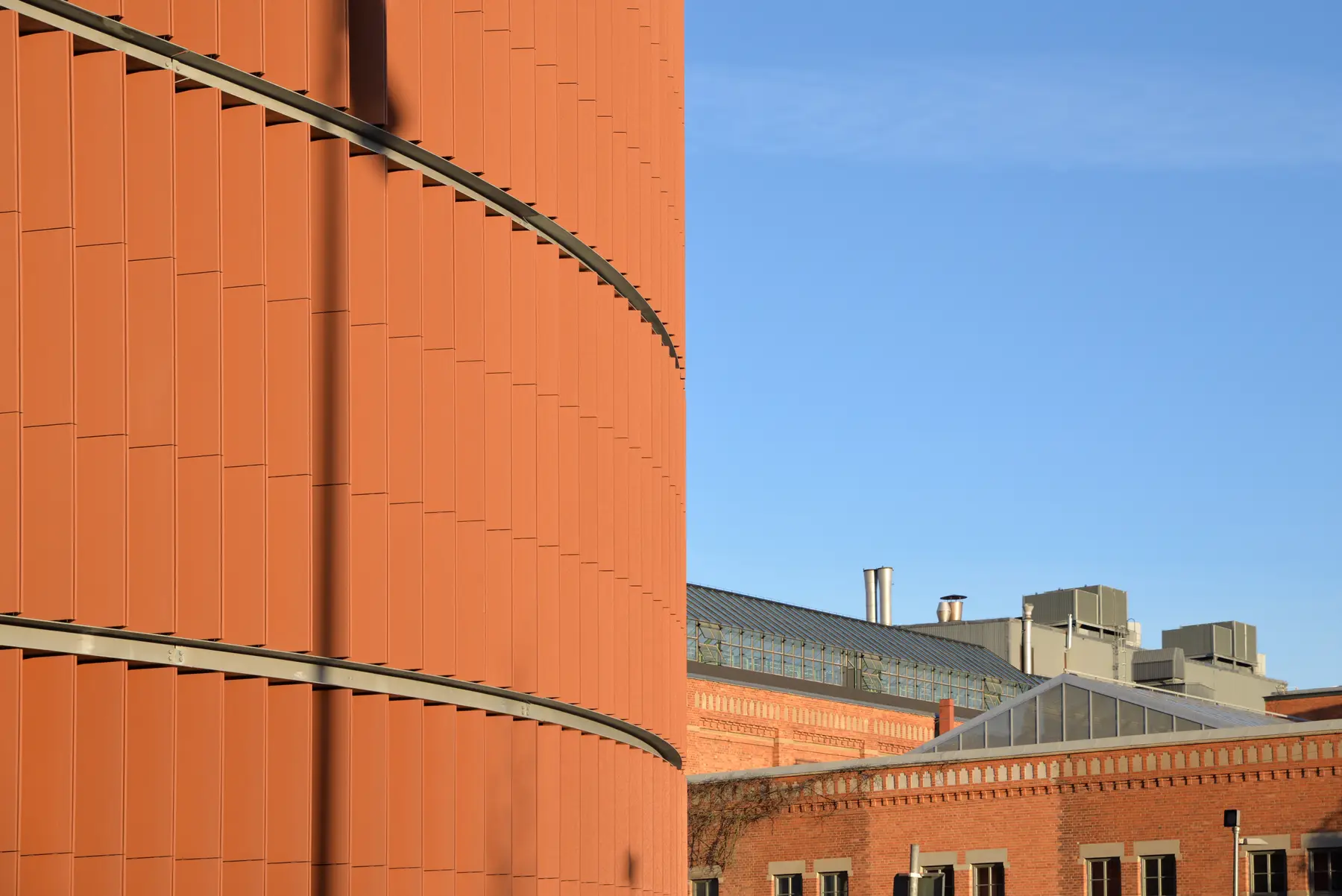
Beside Värtaverket's KVV8, one of the world's largest carbon-capture facilities is taking shape — and an architecture for the city's technical systems.
Adjacent to Värtaverket's KVV8 in Stockholm, one of the world's largest carbon-capture facilities is now being developed. Urban Design is contributing to the strategic design and to shaping the buildings and systems so they become a well-functioning part of the city and Värtahamnen. Bio-CCS stands for bio-energy carbon capture and storage, a technology that separates carbon dioxide from the flue gases and converts it into liquid form. By capturing carbon dioxide, Bio-CCS offers a way to create “negative” emissions instead. The heat generated in the process is recovered as district heating for Stockholmers.
Already with KVV8, an architecture was created that made it possible to place the building in a central location in the Stockholm of the future. Energy production takes up space, but it is necessary for the city to live and function. These buildings and facilities — the urban systems — become natural, fundamental parts of city-building. With the right planning, this architecture of necessity contributes to variety and diversity — just as harbours, breweries and workshops once formed the basis of the mixed city.
Read the original on urbandesign.se →